Preserving memories through painting
Even If This Love Disappears From the World TonightPreserving memories through painting is a recurring idea in Maori Hino’s story: drawing survives the loss of new conscious memories as a bodily skill, then becomes a means of returning to a life and a love she cannot initially recall. The drawings do more than document what happened. They show how experience can remain in practiced movement and emotional response, and how art can give form to a memory that ordinary records cannot restore.
A skill that survives the daily reset
Maori’s anterograde amnesia prevents her from retaining new memories from one day to the next. She can live through a day, but after sleep those experiences are erased; each morning, she returns to the self she was before the accident. Written notes and journals help her learn what has happened, but they cannot make the lost days her own through recollection. Drawing offers a different kind of continuity: a learned ability rooted in physical sensation rather than in the conscious retrieval of events.
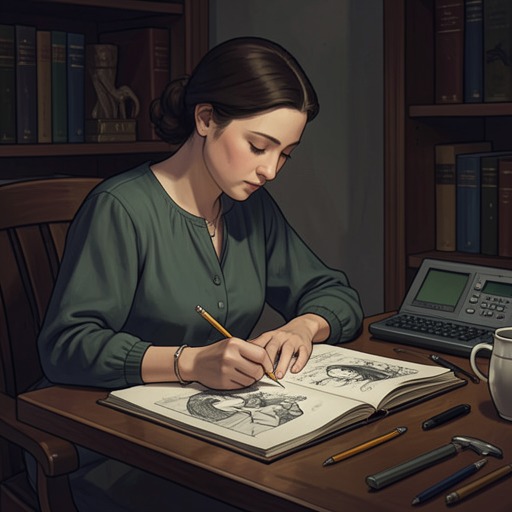
During her amnesia, Maori finds that the drawing practice recorded by her earlier selves is still available to her. She sketches from a film paused on her laptop, concentrating on the sensations of making lines rather than trying to reason her way through the task. Her hand works with an ease she recognizes from junior high, when she drew every day. The lines are more assured than in her first attempts. She understands that she must have been practicing day after day, and that the skillful marks hold evidence of this work even though she cannot remember doing it.
That evidence changes what the daily reset means. Maori cannot preserve autobiographical information in the usual way, but she can continue to practice, improve, and produce something that bears the effects of earlier effort. Drawing gives her a form of development across days that her conscious memory cannot connect. The finished lines belong to the present day’s act of drawing, yet their growing confidence records the accumulated labor of past days.
Images, records, and the missing person
The difference between a drawing and a factual record becomes especially important after Maori recovers. Izumi Wataya and Keiko Nishikawa have removed Tooru Kamiya from her records, and Maori initially has no memory of him. When she sees a sketchbook containing his image, Izumi still describes him only as someone Maori encountered a couple of times at the library during summer break. Izumi knows the sketchbook may unsettle her, but she is uncertain what is best and withholds the truth.
Maori is appalled that she could have forgotten someone she cared for so deeply. Looking at the drawings does not immediately return a conscious memory: she sees different versions of the man but still cannot remember him. Yet she wonders whether her body and heart remember what her mind does not. The sketches thus hold two things apart—the visible image of Tooru and Maori’s absent recollection of the person represented. They testify to attachment without making that attachment instantly legible to her.
Her hesitation over photographs and videos sharpens this distinction. Maori fears that looking at them might replace her own uncertain image of Tooru with the version fixed in recorded footage. Instead, she agrees to hear audio extracted from a video. The sound of her happy voice and the recording’s movement gradually bring back the occasion: the day she insisted that they ride a bicycle together. The episode shows that recorded material can provide a route toward memory, but not all forms of evidence affect her in the same way. Images risk narrowing what she can imagine; sound helps her approach an experience from within.
The recovered drawing
Three years after Maori declares that she will remember everything one day, she is still searching. She uses her journal and Izumi’s stories as guides, revisits places she shared with Tooru, and repeats things they did together. The effort is neither quick nor simple. A scent connected with tea once brings her close to a memory, but the moment does not resolve into full recollection. She continues to look inward, and little by little, Tooru returns to her.
At the cherry-blossom park, Izumi is looking through Maori’s sketchbook when she encounters drawings of Tooru she has never seen before. Unlike the older sketches, in which he looks aside, frowns shyly, or smiles faintly, these pictures show him as Maori now remembers him. Izumi recognizes that the drawings have changed. They are not simply copies of an image preserved from the past; they register a new understanding reached through Maori’s own recovery.
Maori asks to borrow the sketchbook, takes out a pencil, and begins drawing beneath the cherry blossoms. Her forms take shape quickly, the result of drawing every day during and after her amnesia. She sketches Tooru seated beneath a tree, as he appeared on the day the three of them picnicked together. The figure’s tender expression is exact in a way that matters: Izumi recognizes the look Tooru had on that occasion, and understands that a photograph or video could not preserve its particular meaning. The drawing is evidence not only that Maori can depict him, but that she has recovered the quality of a shared moment through her own remembered perception.
As Maori draws, her time with Tooru comes back to her in a rush. She says she has remembered something else but is sure she has not recovered everything. The memories, she believes, have been sleeping in her body and heart; remembering them allows her to continue living with Tooru without denying that he is gone. She feels both pain and warmth, and expects that one day she will reach toward happiness again. Drawing neither cancels grief nor makes recovery complete. It gives her a present action through which memory can return while leaving room for loss and for the life ahead.
What the drawings preserve
The story distinguishes between memory as information and memory as embodied capacity. Maori’s notes can tell her what happened, and her procedural skill can persist without her remembering its acquisition. Later, the recovered portrait adds another dimension: drawing can express the personal meaning of an encounter, not merely reproduce a face. The same medium that records unseen practice during the daily resets becomes, after recovery, a way of recognizing Tooru through a particular expression and place.
That distinction also explains why the drawings matter after Tooru’s death. They preserve neither an unchanging past nor a complete account of him; Maori knows she has more to remember, and that memories may eventually fade. But the act of drawing gives form to a relationship she has chosen to recover, even when the world around her is gradually forgetting him. Her art allows the lost person to remain present in memory without making her a captive of the past.
At the park, this idea reaches its clearest expression. The image of Tooru in the sketchbook is not merely an artifact Izumi can identify; it becomes a drawing Maori makes herself, from the memory she has regained. The story’s closing reflection joins this act to the persistence of the inner world: experiences change, and sorrow changes with them, but the world shaped by the heart through art does not simply disappear. Drawing becomes both a record of accumulated practice and a means of renewing a bond—one that can endure without pretending that loss has been undone.